Information Systems and Technologies Department
About the Department
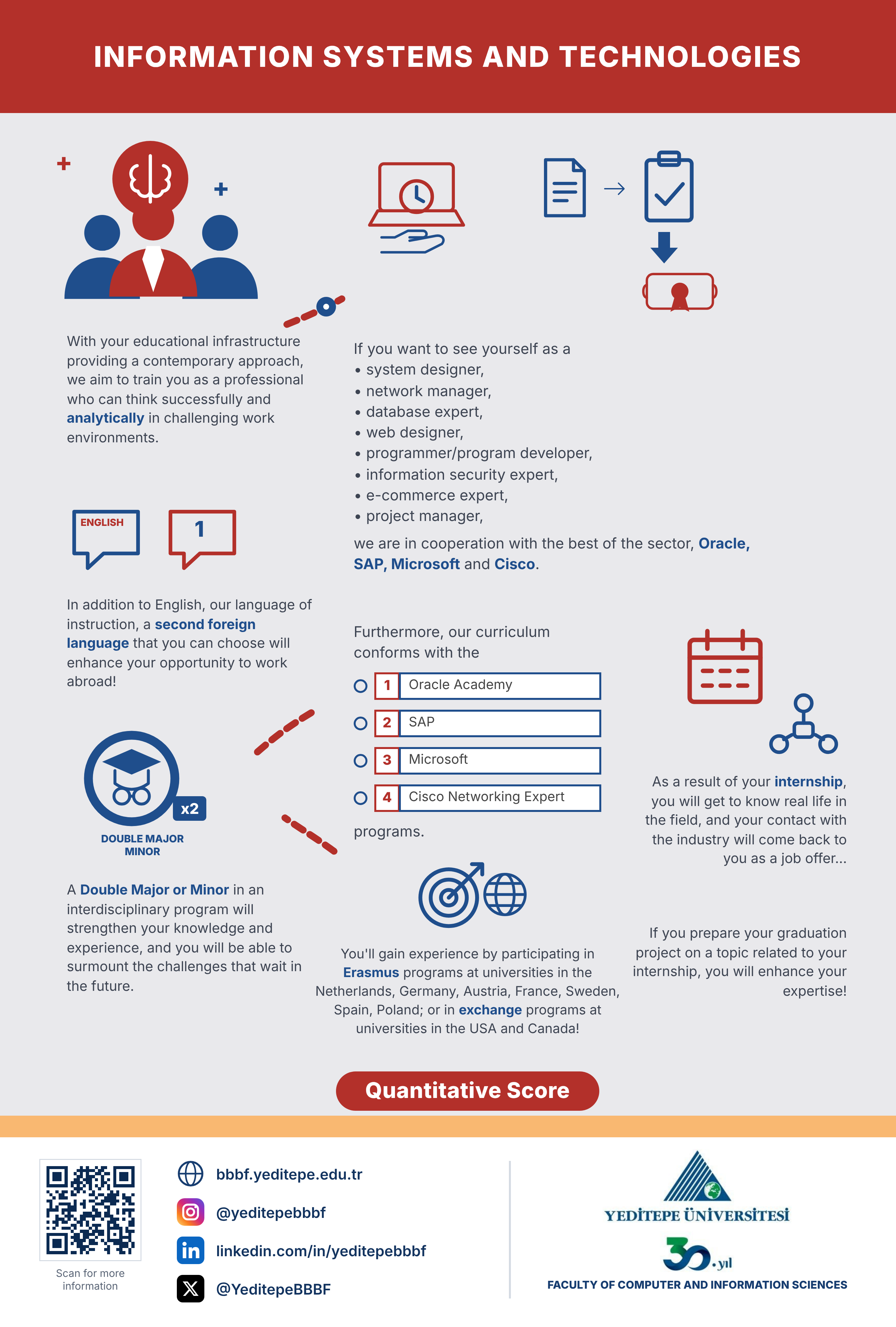
The Department of Information Systems and Technologies at Yeditepe University offers a four-year undergraduate programme that combines technical knowledge in software development, database management, computer networks, and enterprise information systems with business and management knowledge. Based in the Faculty of Computer and Information Sciences in Istanbul, the Department admits students through the YKS numerical (SAY) score type. The programme is taught in English and aims to prepare versatile IT professionals who can analyse an organisation's needs and design and manage the information systems that meet them.
Students learn to develop software with programming languages such as Java, Python, C, and JavaScript, design web and mobile applications, and gain hands-on knowledge of databases, networking, operating systems, and information systems security. Practical sessions in the Faculty's computer laboratories and the graduation project help students experience the full process of an information system, from analysis and design to development and management.
The programme complements technical education with courses in economics, financial accounting, statistics, management information systems, and project management. It aims to help students strengthen analytical thinking, problem-solving, and teamwork skills. A curriculum aligned with Oracle, SAP, Microsoft, and Cisco programmes supports students in preparing for these organisations' certifications alongside their bachelor's degree. A compulsory internship allows students to experience professional life before graduation. In addition, students may choose to join the elective COOP (Cooperative Education) programme, which includes at least 600 hours of work in industry during the final semester.
Information Systems in the Age of AI
Artificial intelligence is rapidly changing how software is developed and how organisations work. This change makes certain specialists even more valuable: people who translate business needs into technical solutions, decide which system should be built and why, and integrate AI tools safely into an organisation's processes. Information systems education sits exactly at this intersection.
Our students build a solid foundation in programming, algorithms, databases, and networking, so they can evaluate what AI tools produce and catch their mistakes. In later years, they can specialise in current technologies through electives such as Artificial Intelligence, Data Mining, Decision Support Systems, Internet of Things, Virtualization and Introductory Cloud Computing, Cryptology and Cyber Security, Penetration Tests and Ethical Hacking, and Blockchain Applications and Cryptocurrencies. The elective Information Technology Management in the Digital Age, taught with Türk Telekom AssisTT, brings current industry practice into the classroom.
Our Mission and Vision
Our Mission
The mission of the Department of Information Systems and Technologies is to educate IT professionals who are proficient in software development, database systems, network management, and enterprise systems, and who can work effectively in national and international industry. The Department pursues this mission through a knowledge-focused approach and an interdisciplinary education.
By combining up-to-date theoretical knowledge with opportunities to apply it, we aim to strengthen our students' research and problem-solving skills and help them become creative, objective, and analytical thinkers. Our goal is to prepare graduates who can take on both technical and managerial responsibilities in IT projects.
Our Vision
The vision of the Department of Information Systems and Technologies is to educate specialists who can analyse an organisation's requirements, design the information systems best suited to its strategic goals, lead development processes where needed, and act as a bridge between managers and technical teams.
Through research and development in information systems, we aim to be a department that follows technological developments closely and reflects them in its curriculum.
History
The Department of Information Systems and Technologies at Yeditepe University admitted its first students in 2001 and has since become one of the University's longest-established undergraduate programmes in computing. Until the founding of the Faculty of Computer and Information Sciences, the Department carried out its educational activities within the Faculty of Commercial Sciences.
The Faculty of Computer and Information Sciences was established by a Presidential decision published in the Official Gazette on 4 August 2022, and the Department of Information Systems and Technologies became one of its founding departments, transferred from the Faculty of Commercial Sciences. Drawing on a quarter-century of experience, the Department continues to develop its curriculum and practical learning infrastructure in line with the current needs of the sector.
Double Major and Minor Programmes
The Department encourages students to combine their computing expertise with knowledge and skills from other disciplines. Double major and minor programmes can help students broaden their academic interests and develop an interdisciplinary perspective. Admission is subject to the University's and relevant departments' applicable requirements.
Double Major Programmes
Eligible students may pursue studies in another undergraduate programme while continuing their Information Systems and Technologies degree. The Department has double major agreements with the programmes listed below; the three that intersect most strongly with information systems are described in more detail.
- Industrial Engineering
- Business Administration
- E-Commerce and Management
- Economics
- Interior Architecture
- International Finance
- International Trade and Business
- Logistics Management
- Mathematics
- Physics
- Radio, Television and Cinema
- Tourism Management
Industrial Engineering
A double major in Industrial Engineering is a strong option for students who want to combine information systems knowledge with the modelling, improvement, and management of production and service systems. Enterprise resource planning (ERP), supply chain management, business process modelling, optimisation, and decision support systems are among the areas where these fields intersect.
E-Commerce and Management
A double major in E-Commerce and Management offers an interdisciplinary learning opportunity for students who want to connect information systems knowledge with digital commerce, online business models, and technology-enabled business processes. E-commerce platforms, customer relationship management (CRM) systems, online sales infrastructure, and commercial data analysis are among the areas where these fields intersect.
International Finance
A double major in International Finance may suit students who want to combine information systems skills with financial systems, international markets, and financial data analysis. Financial technology (FinTech), banking information systems, financial data analytics, and digital finance applications are examples of areas where these fields intersect. As banking and finance are among the sectors where our graduates frequently work, this combination is particularly relevant.
Minor Programmes
Information Systems and Technologies students may apply to minor programmes offered by Yeditepe University, subject to the applicable requirements. A minor can help students complement their main field of study with knowledge and skills from disciplines such as economics, business, design, psychology, and other areas.
The Department also offers an Information Systems and Technologies minor programme for students from other departments within and outside the Faculty. Made up of courses in software development, algorithms, web design, databases, and management information systems, the programme allows students from other fields to complement their studies with information technology skills.
Career Opportunities
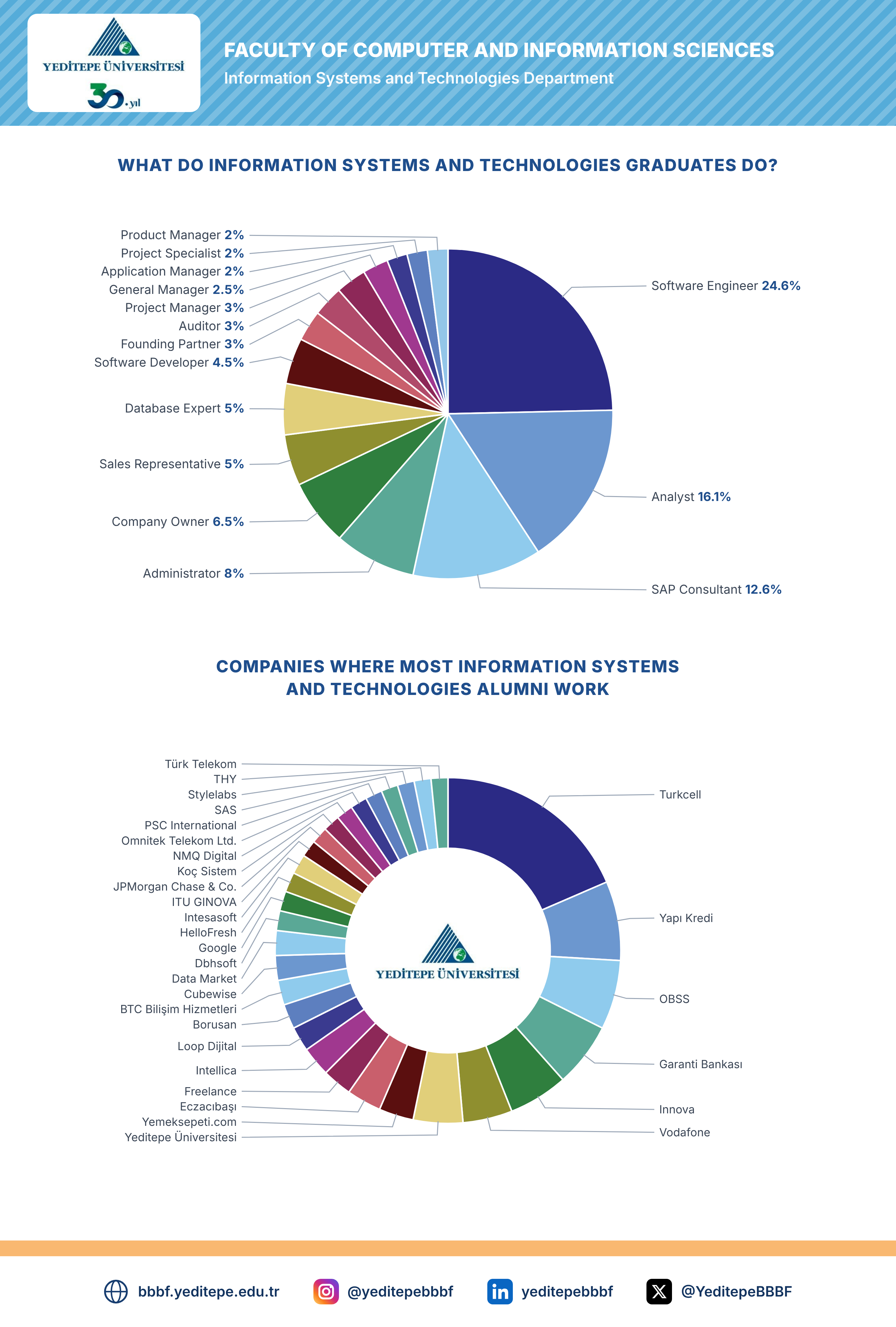
Because they combine technical knowledge with an understanding of business processes and management, graduates of the Department of Information Systems and Technologies can pursue career paths in software development, enterprise systems, data analytics, networking and information security, business analysis, and IT project management. Software engineers, analysts, and SAP consultants are prominent among our graduates. Depending on their interests and specialisation, graduates may seek technical or management-oriented roles.
According to the Turkish Statistical Institute (TÜİK) Higher Education Employment Indicators 2025, bachelor's graduates in information and communication technologies find their first job in 11.4 months on average. This is shorter than the average for all bachelor's graduates (14.2 months) and the second-shortest of any field. The field's registered employment rate, 76.7%, is also above the bachelor's average of 73.9%.
Software and Application Development
Courses in software development fundamentals, object-oriented programming, data structures and algorithms, and web and mobile programming form the foundation of this area.
- Software Developer / Software Engineer
- Back-End Developer
- Front-End Developer
- Full-Stack Developer
- Mobile Application Developer (iOS / Android)
- Web Design and Development Specialist
Enterprise Systems and ERP
Courses in enterprise information systems and management information systems, together with SAP-aligned ERP content, prepare students for enterprise software projects.
- SAP Consultant (Functional / Technical)
- ERP / Enterprise Systems Specialist
- Enterprise Application Manager
- CRM Systems Specialist
- E-Business Specialist
Data and Business Intelligence
Courses in database applications, statistics, data mining, and decision support systems teach students to bring data into decision-making.
- Data Analyst
- Data Engineer
- Database Specialist / Administrator
- Business Intelligence (BI) Specialist
- Data Mining Specialist
Networks, Systems and Information Security
Compulsory courses in computer networks, operating systems, network programming, and information systems security are complemented by electives in cyber security, penetration testing, and cloud computing.
- Systems Administrator
- Computer Network Specialist / Administrator
- Information Security Specialist
- Cloud Systems Specialist
- IT Auditor
Analysis and Consulting
The Information Analysis and System Design course, together with foundations in economics and accounting, develops the ability to turn business needs into technical requirements.
- Business Analyst
- Systems Analyst
- Systems Designer
- IT Consultant
- Product Manager / Product Owner
Project Management and Entrepreneurship
The Project Management course, the compulsory internship, the elective COOP programme, and the graduation project prepare students to take responsibility in real projects.
- IT Project Manager
- Project Specialist
- IT Manager
- Digital Transformation Specialist
- Technology Entrepreneur / Co-Founder
Sectors
Our graduates can pursue careers across a wide range of sectors that use information technologies. IT and software companies, banking and financial services, telecommunications, consulting, education, marketing and advertising, and automotive are among the sectors where our graduates frequently work. E-commerce, insurance, retail, energy, logistics, and public institutions are also potential options.
Organisations where our graduates work include leading companies such as Turkcell, Yapı Kredi, Garanti BBVA, Vodafone, OBSS, and Innova. Depending on their expertise and career goals, graduates may work on enterprise resource planning, software development, data analytics, digital transformation, and information security projects. Technology entrepreneurship and independent consulting are also potential career options.
Academic Careers
Graduates who wish to pursue an academic career may continue to postgraduate study at universities in Türkiye or abroad. Master's and doctoral programmes in areas such as information systems, management information systems, computer engineering, software engineering, data science, cybersecurity, and technology management can provide opportunities to develop deeper academic expertise.
Graduates who choose research and academia may seek to specialise during postgraduate study in enterprise information systems, data analytics, human-computer interaction, information security, and related fields.