Management Information Systems Department
About the Department
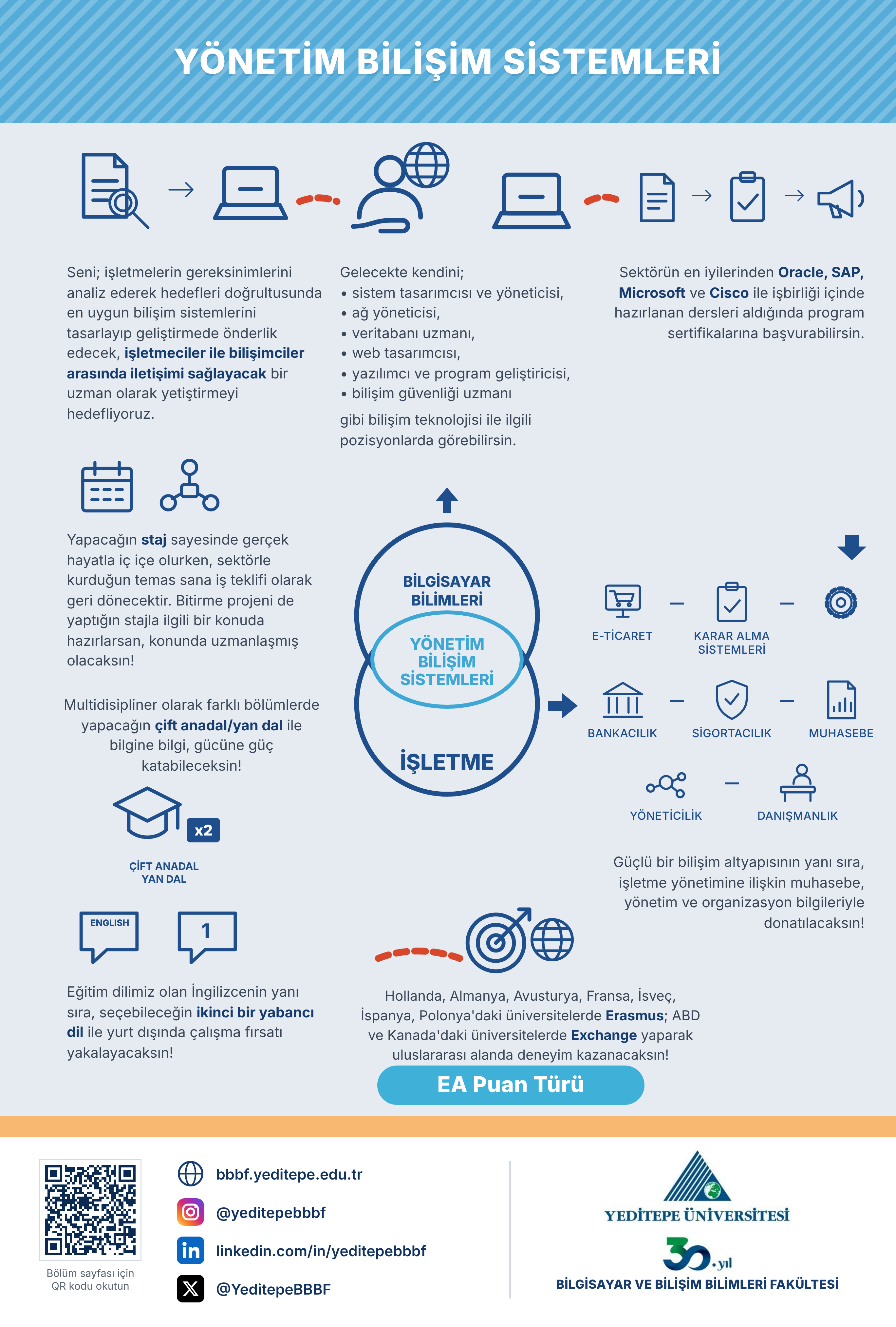
Management Information Systems (MIS) is an interdisciplinary field that brings together management science, information technology, and people. Digital transformation, data analytics, and artificial intelligence are fundamentally changing the way organisations make decisions and do business. In this transformation, organisations increasingly need specialists who understand business needs and can turn them into the right technology solutions. MIS graduates meet this need by building bridges between managers and technical teams.
Our Department, part of the Faculty of Computer and Information Sciences, teaches in English, and students are admitted with the Equal Weight (EA) score type. Alongside technical courses such as programming, database management, systems analysis and design, data analytics, and enterprise information systems, the programme offers comprehensive education in management, business processes, and project management. Through internship and COOP opportunities, our students apply their theoretical knowledge in a professional setting, and through double major and minor programmes they can also gain competence in other disciplines. After their undergraduate studies, our graduates can pursue postgraduate study at universities in Türkiye and abroad, and those who wish can also continue towards an academic career through our Department's master's programme.
Our Mission and Vision
Our Mission
The mission of the Department of Management Information Systems at Yeditepe University is to educate individuals who, through an English-medium and interdisciplinary approach that integrates management science and information technology, can analyse organisational needs; play an active role in the design, development, and management of information systems; and contribute to data analytics- and AI-supported decision-making and digital transformation processes; and to conduct research in these fields that creates value for business and society.
Our Department aims to develop analytical thinking, problem-solving, effective communication, and awareness of ethical and responsible technology use; to equip students with the capabilities to turn theoretical knowledge into practice and with the habit of lifelong learning; and to prepare them for a changing business world.
Our Vision
The vision of the Department of Management Information Systems at Yeditepe University is to be a nationally and internationally recognised and preferred department that stands out at the intersection of management and information technology, particularly through innovative education and research in data-driven decision-making, artificial intelligence, and digital transformation, and that builds bridges between academia and the business world.
History
The Department of Management Information Systems admitted its first students in 2008 within the Faculty of Commercial Sciences and graduated its first cohort in 2012. Since its foundation, the Department has been structured as a programme that combines business knowledge with information technology.
Following the closure of the Faculty of Commercial Sciences, the Faculty of Computer and Information Sciences was established by a Presidential Decision published in the Official Gazette on 4 August 2022. MIS was one of the first three departments transferred to the new Faculty, took part in its foundation, and continues its education within this Faculty today.
Double Major and Minor Programmes
MIS students can add another field to their undergraduate studies and graduate with a second bachelor's diploma or a minor certificate. Admission to these programmes depends on the conditions set by the University and the relevant department; the programmes listed below are options for students who meet these conditions.
Double Major Programmes
The double major programme allows MIS students who meet the necessary conditions to complete a second undergraduate programme while continuing their own degree; application conditions are set separately for each programme. The Department's current double major agreements span several fields: in business, economics and trade, Business Administration, Economics, International Finance, International Trade and Business, E-Commerce and Management, Logistics Management, and Tourism Management; in quantitative fields, Industrial Engineering and Mathematics; in communication and design, Visual Communication Design, Advertising Design and Communication, and Public Relations and Publicity; and in public administration, the social sciences and languages, Public Administration, Sociology, and Translation Studies.
Business Administration
Because MIS already includes business courses, a double major in Business Administration extends this foundation into marketing, finance, human resources, and strategy. In enterprise resource planning projects, business analysis, and digital transformation consulting, the two degrees complement each other directly.
Economics
A double major in Economics combines the data-handling skills gained in MIS with the analysis of markets and economic decisions. It is a strong combination for students who want to work on econometric modelling, demand forecasting, and the digital economy.
International Finance
Banking and finance are among the sectors that invest most heavily in information systems. A double major in International Finance appeals to organisations looking for professionals who understand both the financial logic and the systems side of payment systems, risk management software, and FinTech solutions.
International Trade and Business
This programme adds foreign trade operations, export and customs processes, and global market strategies to MIS knowledge. It is a meaningful choice for students who want to build the digital trade infrastructure of exporting companies or manage international operations data.
E-Commerce and Management
The E-Business and web design courses in MIS are a natural starting point for this double major. The programme deepens students' knowledge of online store management, digital marketplaces, customer data analysis, and e-commerce operations.
Logistics Management
Today every logistics step, from the warehouse to delivery, is tracked by software. A double major in Logistics Management prepares MIS students who learn supply chain planning and transport operations to work on the logistics modules of ERP systems and on implementing warehouse management systems.
Tourism Management
Hotel reservation systems, online travel agencies, and revenue management software form the information systems side of the tourism sector. A double major in Tourism Management is aimed at students who want to manage these systems with an understanding of how the sector works.
Industrial Engineering
Process modelling, optimisation, and production planning are where industrial engineering meets MIS most closely. This double major gives quantitative depth to students who want to work on ERP implementations and decision support systems, particularly in manufacturing and supply chain companies.
Mathematics
Behind MIS electives such as data mining and artificial intelligence lies strong mathematics. A double major in Mathematics suits students who want a solid grounding in probability, linear algebra, and modelling and who are considering data science or academic work in the future.
Visual Communication Design
The success of an information system also depends on how easily people can use it. A double major in Visual Communication Design complements the web design courses in MIS with a design-oriented perspective on user interfaces, user experience, and information visualisation.
Advertising Design and Communication
Advertising today is largely carried out on digital platforms through campaigns whose results are measured with data. This double major brings advertising strategy and creative communication together with MIS skills in data and digital marketing.
Public Relations and Publicity
An organisation's reputation is now shaped largely on social media and digital channels. A double major in Public Relations and Publicity gives MIS students who learn corporate communication and reputation management the opportunity to stand out in measuring and managing digital communication.
Public Administration
E-government services and the digitalisation of public institutions are increasing the need for information systems specialists who understand public administration. A double major in Public Administration combines administrative structures and public policy with MIS knowledge, opening the way to work in the public sector or on technology projects that serve it.
Sociology
Understanding how technology affects users and society is a prerequisite for well-designed information systems. A double major in Sociology gives students who want to study user behaviour, digital communities, and the social consequences of technology a strong grounding in research methods as well.
Translation Studies
Adapting software and digital content to different languages is a growing field where language meets information technology. A double major in Translation Studies appeals to MIS students who want to work on localisation projects, translation technologies, and multilingual digital products.
Minor Programmes
Students who prefer a shorter programme than a double major can apply for one of the University's minor programmes. A minor provides foundational competence in another field through a limited number of courses alongside the main degree and is certified on graduation.
MIS also offers its own minor to students from other departments. Consisting of courses in programming, algorithms, data structures, web design, database applications, and management information systems, the MIS minor allows students of business, communication, or the social sciences to add an information systems dimension to their own field.
Industry Collaborations
The Department of Management Information Systems works in close collaboration with industry to ensure that its education matches the real needs of the business world. These collaborations help our students turn theoretical knowledge into practice, gain professional experience before graduation, and build their career networks early.
Cooperative Education (COOP)
Under the Faculty's COOP programme, our students spend their final semester at partner organisations, working for at least 600 hours. The process is run jointly by a COOP advisor appointed by the Department and a workplace supervisor; the graduation project is prepared as part of this work, and the workplace supervisor also attends its presentation. In 2025 and 2026, students of our Faculty completed the COOP programme at organisations such as Venhancer Bilişim ve Danışmanlık, Netaş Telekomünikasyon, and Intellica; in Spring 2026, a student from our Department took part at Venhancer.
Industry-Supported Training Programmes
The Low-Code ERP Training Programme (September 2026), organised at Yeditepe University in collaboration with 1Ci, offers MIS students hands-on software development on the 1C:Enterprise platform, workshops based on real ERP business scenarios, and mentoring from industry experts. Successful participants can benefit from internship and career opportunities.
Industry Meetings in Courses
Industry representatives are welcomed as guest speakers in various courses in our Department. In these sessions, our students have the opportunity to hear about current topics from practitioners in the field, learn directly about the expectations of the business world, and expand their professional networks.
University-Level Opportunities
Our students meet industry executives and alumni at the İZ Career Festival organised by Yeditepe University's Student Centre and take part in interview simulations and career workshops. Students with technology-based business ideas can benefit from the entrepreneurship support offered by Yeditepe Venture Studio in collaboration with TÜBİTAK BiGG.
Internship
Through our compulsory internship programme, our students experience first-hand how information systems are designed, operated, and managed in organisations.
International Exchange Programmes (Erasmus+)
Through the Erasmus+ programme, MIS students can spend a semester at partner universities in Europe. This experience helps students become familiar with a different education system and culture, improve their foreign language skills, and develop an international perspective. Courses taken abroad replace courses in the MIS programme in line with a learning agreement prepared before the mobility period.
Under the Faculty's Erasmus+ agreements, the institutions MIS students can apply to include HU University of Applied Sciences Utrecht and Windesheim University of Applied Sciences in the Netherlands, the University of Extremadura and the University of Granada in Spain, and the University of Graz in Austria. Quotas at these institutions are shared with the Faculty's other departments.
Erasmus+ applications are made during the periods announced by the International Office and are subject to conditions such as grade point average and foreign language proficiency. Language requirements are set separately for each partner university; some institutions also require Spanish or German in addition to English.
Career Opportunities
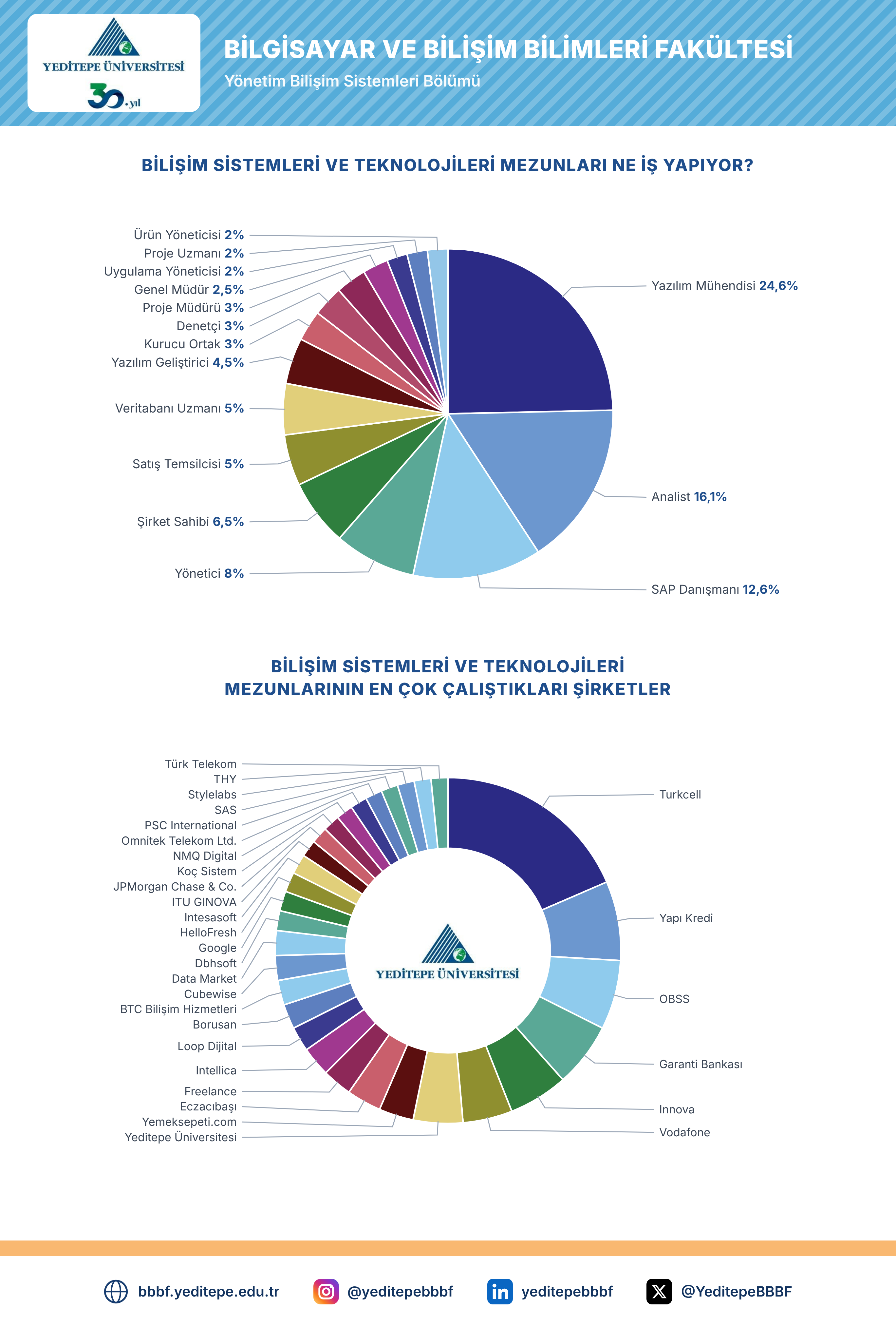
Because they can build bridges between managers and technical teams, MIS graduates stand out in roles positioned between an organisation's business units and its IT units. Our graduates can work in positions such as business analyst, data analyst, systems analyst, ERP/enterprise systems consultant, IT project manager, digital transformation specialist, product manager, and IT audit/information security management.
Business and Systems Analysis
- Business Analyst
- Systems Analyst
Data and Analytics
- Data Analyst
- Business Intelligence (BI) Analyst
Enterprise Systems
- ERP / Enterprise Systems Consultant
Project, Product and Transformation Management
- IT Project Manager
- Product Manager
- Digital Transformation Specialist
IT Audit and Information Security
- IT Auditor
- Information Security Management Specialist
Sectors
Our graduates are needed in almost every sector that uses information systems, particularly banking and finance, consulting, e-commerce, telecommunications, manufacturing, healthcare, and public institutions.
In these organisations, graduates most often work on ERP and enterprise system projects, the digitalisation of business processes, data analytics teams, IT project management, or IT audit and information security units.
Academic Careers
Graduates considering an academic path can pursue master's and doctoral studies in Türkiye or abroad in fields such as management information systems, business analytics, data science, information systems, business administration, information security, and artificial intelligence. Because MIS combines management and information technology, graduates have the flexibility to apply to postgraduate programmes rooted in either business or computing.
In addition to these options, for graduates who wish to continue their studies at Yeditepe, the English-medium Management Information Systems master's programme is offered with thesis and non-thesis options. The thesis option suits preparation for an academic career and doctoral study, while the non-thesis option suits professional specialisation; Yeditepe graduates are exempt from the programme's English proficiency exam.